In this episode of the 720 System Strategies podcast, I sit down with influencer and bankruptcy attorney Adrienne Hines to talk about something many firms struggle with every year: whether it makes sense to keep following up with bankruptcy leads during the holidays.
Adrienne is not only a longtime consumer bankruptcy lawyer, she is also one of 720 System Strategies’ top influencers, responding to thousands of comments and direct messages every week. Her perspective goes far beyond one local market.
Together, we unpack why this holiday season looks different from prior years, how wage garnishments and collection activity are driving people to take action, and why attorneys who stay engaged in December are seeing packed calendars and surprising conversion rates. We also dig into the emotional side of debt during the holidays, the importance of leading with the word “bankruptcy” instead of vague “debt solutions,” and what is working in practice for consultations, phone calls, Zoom, and texting.
FAQ: Are holiday bankruptcy leads worth following up, or are debtors checked out until January?
Holiday leads are absolutely worth following up. While many firms historically slowed down in December, this year looks different. Phones are ringing earlier, and people are not waiting until January to ask for help. Fear of garnishments, collections, and holiday costs is driving earlier action.
December has become a prime time to educate, build trust, and line clients up to file immediately after the holidays instead of starting January with an empty calendar.
FAQ: Why does this holiday season feel different from past years for bankruptcy practices?
Several pressures are hitting at once. The economy is tight, collection activity is aggressive, and in some states wage garnishments are increasing. In prior years, debtors hoped January would magically fix things. Today, more people understand that waiting does not change the math.
This realism, combined with financial stress and holiday expectations, makes people more open to bankruptcy conversations earlier than in past years.
FAQ: How should I approach holiday leads without feeling like I am selling during a sensitive time?
The shift is from selling to coaching. Debtors do not want pressure. They want guidance. That means offering clear advice about credit card use, gifts, preferences, transfers, and payday loans so they do not damage their case before filing.
Frame the consultation as planning for January or for their next move. When you lead with protection and clarity, retainers and deposits follow naturally when clients are ready.
FAQ: What kind of results are attorneys actually seeing when they keep taking appointments in December?
Attorneys who stay active are seeing strong results. One example showed 18 consultations in a single December week, with only two no-shows and 12 signed fee agreements with deposits collected.
Many of those clients plan to file after the holidays, but they are already retained and moving forward. That creates a strong January pipeline instead of a cold restart.
FAQ: What should I tell prospects about holiday spending, gifts, and credit card use if they plan to file?
This is where your value is highest. Clients do not know the rules around luxury spending, cash advances, preferences, or transfers. You do.
Encourage them to talk with you before using credit, explain what is safe and what is risky, and give simple written guidelines for holiday spending. That guidance positions you as a protector, not a salesperson.
FAQ: How are debtors thinking about credit scores and programs like 7 Steps to a 720 Credit Score?
Debtors are more focused than ever on life after bankruptcy. Many want to know what their credit will look like, how long rebuilding takes, and what steps come next.
Talking about programs like 7 Steps to a 720 Credit Score shows clients that bankruptcy is not the end of their financial story. Pairing immediate relief with a clear rebuild plan creates hope and increases conversion.
FAQ: Should I market debt solutions or say bankruptcy directly in my messaging?
Clear messaging works better. When firms avoid the word bankruptcy and advertise vague debt solutions, lead costs rise and confusion increases. Borrowers know what bankruptcy is, even if they are nervous about it.
Leading with bankruptcy attracts people who are ready for a real solution and filters out those looking for unrealistic alternatives.
FAQ: Is phone, Zoom, or in person better for consultations with today’s bankruptcy leads?
Phone consultations outperform Zoom and in-person meetings for initial calls. Attorneys report higher answer rates, lower no-shows, and better engagement.
With phone calls, you initiate the contact. With Zoom, clients must navigate links and technology, which often increases avoidance. Many firms reserve Zoom for later steps, not the first conversation.
FAQ: How should I use text messaging with leads and active clients?
Texting is essential. Most people read texts even if they ignore email. Use texts to confirm appointments, follow up quickly on missed calls, and maintain momentum.
After retention, move clients into case-based texting within your CRM or case management system. Avoid personal phones to maintain boundaries and reduce risk.
FAQ: Why is empathy so important right now, and how does it affect reviews and long term growth?
Holiday debt often feels like a private crisis. Clients may look functional while feeling overwhelmed and ashamed. Calm, nonjudgmental guidance at that moment creates deep trust.
Clients remember who helped them feel safe during their hardest season. Those experiences drive heartfelt reviews, referrals, and long-term reputation growth well beyond the holidays.
In the November strategy call, we discussed the seven value-adds that every bankruptcy attorney should offer. The full video is below, and here’s the short version: if you want to win more consults and raise fees without losing bookings, stack real value that matters to debtors after the case. Give them a free path to rebuild credit, fix post-BK reporting errors, line up a car if they need one, map the road to a mortgage, stay in touch with useful emails, plug them into community support, and screen student loans under the DOJ guidance. When you say it simply and offer it up front, price shopping fades and trust goes up.
FAQ: What are the seven value adds I can offer right now?
You can offer a free credit rebuilding course, a free post-bankruptcy credit report review, a welcome call that turns advice into steps, a free car audit through a BK-friendly dealer, a clear plan to buy a home later, a monthly email that adds value and gathers reviews, and an invite to a large BK support group. All seven are practical, repeatable, and easy to explain in a consult.
FAQ: How exactly do I present the 720 credit course so it helps me close?
You present it as “credit rehab included.” Say, “You will get 7 Steps to a 720 Credit Score at no cost through Evergreen. Short videos, templates, and a simple plan to rebuild in 12 to 24 months.” Position it as life after discharge, not theory. Your line is, “I don’t want you worrying about credit. I’m giving you the playbook.”
FAQ: What do I say about the free post-bankruptcy credit report review?
You explain that many reports show errors after discharge and you have a process to catch and fix them. Say, “We will review your report, compare it to your discharge, send certified disputes if needed, and recheck in about 45 days. You should not carry debts that the court already erased.” It is protection and peace of mind.
FAQ: How does the welcome call work and what happens on it?
You explain that your client gets a quick call to turn the plan into action. Say, “On the welcome call, you’ll set up the free report review, get a current list of starter cards that are approving after BK, learn your installment options, and get a path toward a car or a home if that is your goal.” It makes the program real and gets them moving.
FAQ: How do I talk about cars without sounding like a dealership?
You frame it as a car audit, not a pitch. Say, “If a car is on your mind, we’ll connect you to Ash Auto Group for a free audit. They check the value of your current car, walk through approval options during or after the case, and ship nationwide. You decide, no pressure.” It removes fear and speeds decisions.
FAQ: What can I promise about getting a home after bankruptcy?
You promise a roadmap, not guarantees. Say, “You can talk now with a nationwide mortgage pro about timelines and down-payment assistance programs. We’ll send you education so you know what score, income, and waiting period you’ll need. If a home is your goal, we plan toward it from day one.” Hope plus steps beats vague maybes.
FAQ: How do the emails and support group actually help my practice?
You stay useful after filing and let happy clients talk about you. Say, “You’ll get short monthly tips on using your fresh start, with a simple review link at the top. We also invite you to Bankruptcy Support Group USA for peer advice between attorney calls.” This keeps you top of mind and gently grows referrals.
FAQ: Is there a student loan value add that won’t eat my time?
You can screen fast and refer when it’s a fit. Say, “If your loans are older, payments are unaffordable on a standard plan, or health limits work, we’ll screen under the current DOJ guidance. If it looks good, we proceed or connect you to a trusted partner.” It shows you see the whole picture without taking on work you don’t want.
FAQ: How do I use these value adds to handle price objections?
You pivot from price to outcomes. Say, “Any competent attorney can file forms. I’m also giving you credit rehab, a clean report, a step-by-step plan for a car or a home, ongoing support, and a student loan screen. That’s your future, not just a discharge.” When clients picture the outcome, a few hundred dollars difference feels small.
Starting a bankruptcy practice is part legal skill and part business build. The attorneys in this video share what they wish they had done on day one: get real lead flow, set up a simple repeatable process, lean on community, and use tech to work faster without adding overhead.
FAQ: What would you do first if you were starting today?
Hire or partner with someone who can bring in ready-to-file leads. Great legal work does not matter without clients. Set a modest monthly budget for lead generation from day one and track every dollar to signed cases.
FAQ: How should I think about marketing if I have limited cash?
Go heavy on social media and direct outreach. Post useful tips, short videos, and client stories. Join local groups, answer questions, and point people to a simple intake link. Organic content costs time, not cash, which is perfect at launch.
FAQ: What systems should I set up before I open the doors?
Create a simple written workflow from first call to filed case. Use one case management tool like Best Case or Jubilee. Add online intake, e-signature, and a shared checklist so the same steps happen every time.
Not you. Use an answering service or intake specialist so every call is picked up and qualified. Missed calls are missed cases. 720 System Strategies uses non-attorney salespeople who know how to connect with the potential clients’ deepest pain points and overcome the obstacles to filing.
Earlier than you think. Start with a part-time or contract paralegal. Give them your workflow and have them own document collection and follow-ups. Your time should go to consults, signing clients, and court work.
FAQ: How do I keep leads from slipping through the cracks?
Build a basic follow-up ladder on day one. A new lead gets a call within five minutes, then a text, then an email, then reminders until they schedule. Track every lead source and conversion so you can double down on what works.
Mix paid and unpaid. Paid sources include targeted digital ads and reputable lead partners. Unpaid sources include referrals from past clients, other attorneys, realtors, and financial counselors. Thank referrers quickly and keep them updated so they send the next case.
Very. Join NACBA and local bar groups. Attend trainings. Ask a busy practitioner if you can help for a few months to learn their flow. A mentor can cut months off your learning curve.
Treat education like a standing bill. Take foundational bankruptcy courses now, then repeat them next year. You will catch details you missed once you have active cases.
Consider a focused niche like small business debtors, student loan adversaries, or Spanish-language consumer work. Become the go-to for that slice and let other lawyers send you those matters.
Pick a clear name people can remember. Location matters less if your intake is digital, but choose an area that is growing and easy to reach. Keep rent low and spend on marketing and systems instead.
Start with one laptop, cloud case management, secure cloud storage, e-signature, online scheduling, and call routing. Go paperless from day one. Automate routine emails and reminders using 720 System Strategies.
Either is fine if your software runs well on it. Many lawyers like Apple for stability and easy syncing. Choose the platform you will maintain with the least friction.
FAQ: What are the must-do administrative steps in week one?
Set up a separate intake phone line, a simple website with an online scheduler, a dedicated client email, and a trust account if your state requires it. Build your templated emails and document requests before the first consult.
FAQ: How do I handle client gratitude and referrals the right way?
After a successful case, ask for a review, thank the client, and note who referred them. Keep a light quarterly update to past clients so they remember you and know what else you handle.
FAQ: What common mistakes should new bankruptcy lawyers avoid?
Waiting to market until everything feels perfect, answering every call yourself, skipping a written process, and overspending on office space. Keep costs lean, measure results, and iterate.
In this episode of the 720 System Strategies podcast, Igor Roitburg, senior managing director at Stretto, and I dig into the new DOJ guidance for student loan discharge in bankruptcy, why results have jumped, and how consumer firms can add a profitable, client-saving service right now. We also cover continuity under the current administration, what facts to screen for, realistic fees, and a simple workflow that gets you from intake to a filed adversary with confidence.
FAQ: Why should bankruptcy attorneys revisit student loans now?
Bankruptcy attorneys should revisit student loans because the process works. Since the DOJ and Department of Education released their guidance in 2022, reported outcomes through late 2024 show roughly 85% of cases receiving some discharge — about 70% full and 15% partial. That is a major shift from the near-zero success rate many remember from the past.
FAQ: Is the guidance still active under the current administration?
Yes. AUSAs are still proceeding, and the DOJ has updated both the attestation form and its public guidance page, signaling ongoing support. The framework traces back to a 2018 request for information about undue hardship, so it has roots that predate the 2022 rollout.
Strong cases show current inability to afford standard repayment, limited future earning capacity, a repayment history of roughly ten years or more, and any health issues affecting work. The affordability test now uses a standard repayment amount instead of IDR, which makes the math simpler and easier to meet. Older borrowers often meet the future-ability prong naturally.
FAQ: How do I explain “what changed” to my team and clients?
The statute itself did not change. The guidance organized existing law and case history into a clear, objective playbook that AUSAs now follow. This structure reduces guesswork, shortens analysis time, and improves consistency in case outcomes.
FAQ: What fees are firms charging, and is there any court guidance?
Reported fees range from about $2,500 to $7,500 depending on case complexity and local practice. The Northern District of California established a $4,500 no-look fee, which many attorneys use as a baseline when setting pricing.
FAQ: What quick tools help me screen and assemble the filing?
Stretto’s Discharge Snapshot is a free two-minute screener that flags likely candidates. The Discharge Analyzer costs $29 and produces a detailed assessment aligned with DOJ guidance. For $99, you can generate a prefilled attestation, draft adversary complaint, and a customized document checklist so your file is ready and complete.
Start with a quick screening to filter out weak cases. If viable, complete a full analysis, collect all supporting documents, and prepare the attestation package. File the adversary proceeding with the attestation and exhibits, then follow the playbook the guidance provides step by step.
FAQ: Do I have a duty to bring this up with clients?
Many professionals in the field believe you do. Student loans are often a client’s second-largest liability after a mortgage. At a minimum, raise the topic, explain the criteria, and offer a pathway to assess eligibility — even if your firm refers out the work.
FAQ: How do I talk about results without overpromising?
Share what current data shows and connect it to case facts. Emphasize that outcomes have improved because the process is clearer and more objective, but results still depend on affordability, future capacity, repayment history, and documentation quality. Transparency builds trust without overselling results.
FAQ: Where can I access the screening and document tools?
Go to dmmportal.com to log in and launch the Snapshot, Analyzer, and attestation package. Use the free Snapshot for triage, then upgrade for deeper analysis or to generate a ready-to-file packet when a case qualifies.
Watch the interview below with Larry Friedman, former Director of the Executive Office for U.S. Trustees and now Chief Strategist at Invoygo. We talk through how debtor attorneys can: 1) set client expectations, 2) use a payment portal, and 3) raise collection rates without hiring a big in-house collections team.
Here are a few of the questions answered during this podcast.
FAQ: How do debtor attorneys get paid reliably on post-petition work?
Getting paid reliably on post-petition work starts with clear expectations and an easy way to pay. Set a firm service-for-fee agreement, confirm the amount and cadence the client can handle, and route payments through a client portal that supports reminders and card updates.
Reinforce that payment is part of the professional relationship, the same as any service the client provides in their own job. When payment is simple and expectations are clear, clients are more likely to follow through.
FAQ: What does a payment portal need to include for bankruptcy clients?
A useful portal lets clients log in, see their contract, make full or partial payments, update cards, and message support. It should send friendly pre-debit notices a few days before each charge and quick reminders after a miss. Keep date changes and edge cases with your support team so controls stay tight while clients get flexibility.
Follow up lives with the system first and your team second. Automated notices should go out immediately, and staff should check the portal before or during routine case calls to confirm whether the payment landed.
If it did not, bring it up calmly: “I noticed last month’s payment didn’t process. Can I help you update your card?” This defuses pressure and opens the conversation.
FAQ: Do bankruptcy clients really want to pay their lawyers?
Yes. Clients value the relief you deliver and expect to compensate you for it. Position the fee next to the outcome. A client discharging $25,000 to $75,000 in debt sees a $2,400 fee as reasonable when you explain the support and results.
FAQ: What collection rates should a firm expect on post-petition plans?
Firms that communicate well and use a portal commonly report 80–90% collection rates, with well-run programs breaking 90%. Prevent first-payment defaults: confirm affordability up front, schedule the first draft quickly, and verify the payment hit before proceeding.
FAQ: How should I talk about money without sounding like a collector?
Recast financial obligations as part of client care: you’re helping them get relief, and payment is how you keep helping. Use plain language, empathy, and questions that check comfort and capacity.
Try: “Is $200 on the 15th still workable for you, or would biweekly $100s help while you get through the 341 period?”
FAQ: What should my intake or legal team say about payments during active work?
Tie payment checks to moments you already talk to clients. During the first 90 days—document requests, trustee questions, hearing prep—confirm the latest payment and use the portal as your single source of truth. If a payment failed, ask what changed and text the portal link so they can update the card while on the line.
FAQ: How much do merchant fees cost and how do third-party services compare?
Traditional card processing often lands near 3.1–3.5% plus monthly fees and compliance overhead. A serviced platform that bundles banking, compliance, support, and software may run about 6% of amounts collected. Compare total cost to net outcomes—if the platform lifts collection rates and replaces a dedicated collector, the delta can favor the platform.
FAQ: How can a firm test a payments platform without big risk?
Run a champion-challenger test: keep a control group on your current process and place a matched group on the platform for 60–90 days. Track first-payment success, total dollars collected, failed-payment recovery, and staff minutes. Choose the winner by net dollars after fees and labor.
FAQ: What client scripting helps prevent first-payment defaults?
Confirm comfort with amount and frequency, lock the first draft date, and send the portal login immediately. Add a short welcome note that frames the provider as a trusted partner. Include one or two lines in your engagement letter and a separate intro email. Tell clients how to text or call for help and what to do if a card changes.
Watch the interview below with Erik Clark of Borowitz & Clark on building a process-driven, scalable bankruptcy practice. We cover the software stack, case staging, automation, staff training, and why engaging with the court and bar community pays off for your firm and your clients.
Watch & Learn: How to Scale a High Volume Bankruptcy Practice
FAQ: How do you scale a high volume bankruptcy practice?
Scaling a high volume bankruptcy practice starts with repeatable processes, strong software, trained people, and active engagement with your local bankruptcy ecosystem. Chapter 7 and Chapter 13 matters follow predictable paths, so map those paths, stage each case, and track movement through those stages.
Build a conveyor belt of steps from intake to post-filing, then use your tools to keep every file moving. When a case does not fit the mold, train your team to spot it, pull it off the belt, troubleshoot, and return it to the flow once resolved.
FAQ: What core software does a modern bankruptcy firm need?
A modern bankruptcy firm needs petition preparation software and a customizable CRM or case management system that reflects Chapter 7 and Chapter 13 workflows. Off-the-shelf tools can work if you adapt them to bankruptcy and keep them current with cloud capabilities.
Use your CRM to define stages such as document collection, petition prep, filing, and post-filing. Track every matter by stage, capture notes that give context at a glance, and make sure your system supports both automation and reporting.
FAQ: Should I customize my CRM or buy off the shelf?
You should start with a widely used legal CRM or case management platform, then customize it for bankruptcy. No tool is perfect out of the box, so budget for development time to align fields, stages, and automations with your process.
This investment pays back by cutting manual data entry, reducing misses, and giving your team a single source of truth. As technology evolves, revisit your build and keep tuning it.
Structure cases into stages that mirror the real work, like intake triage, document collection, petition preparation, filing, trustee interactions, plan confirmation, and post-filing follow-through. Make the stages different for Chapter 7 and Chapter 13 where needed.
Assign owners to each stage and define the handoff triggers. Your system should show at a glance where a file sits and what must happen next.
Automate lead capture into the CRM, intake scheduling, document requests and reminders, and standard status updates. These steps are high volume and rules-based, so automation saves hours and keeps clients informed.
Feed new leads straight into your system with a concise case snippet so callers have context before they pick up the phone. Reserve human attention for analysis and exceptions.
FAQ: How should I train staff in a process-driven practice?
Train staff with a mix of internal playbooks and external education from local bar groups, your court, software vendors, and NACBA programs. Consistent training helps your team issue-spot and know when a case needs special handling.
Invest the time up front and you will see fewer errors and smoother handoffs. Keep a running library of checklists, screen recordings, and templates tied to each case stage.
FAQ: Is it better to cross-train or compartmentalize roles?
Both can work, but compartmentalizing by stage is effective at scale. For example, dedicate one team to prospective clients and early emotional support, another to pre-filing tasks, and another to post-filing work.
Specialization builds speed and depth. If you prefer cross-training, add clear guidelines for when to escalate unusual facts so nothing slips.
FAQ: How should intake handle the first call with a lead?
Intake should come prepared with context from the CRM, speak with empathy, and set realistic expectations about bankruptcy relief and next steps. Many callers arrive with shame and myths, so meet them where they are and educate without judgment.
Give your intake team scripts that normalize bankruptcy as a fix for life events like illness, divorce, or job loss. The goal is to build trust quickly and guide the caller onto your process.
FAQ: Why should debtor attorneys engage with the court and bar community?
Engaging with the court, trustees, and local bar groups helps align firm processes with court realities and can drive system-level improvements. Feedback loops with clerks, judges, and the U.S. Trustee can remove roadblocks for everyone.
This work takes time, yet it improves efficiency and outcomes for debtors and firms alike. It also builds credibility that benefits clients and the larger debtor bar.
FAQ: What are the three pillars to prioritize before marketing?
Prioritize software and systems, people and training, and community involvement with your court and debtor bar. Marketing matters, but these three pillars create the capacity and quality that make marketing spend worthwhile.
Once your conveyor belt runs clean, your team is trained, and your court relationships are strong, new cases slot in smoothly and clients get better results.
I sat down with M. Erik Clark of Borowitz & Clark, the Central District of California’s Bankruptcy Attorney of the Year. We talked about practical ways debtor attorneys can shape local rules, why steady communication with judges and trustees matters, and how coordinated advocacy led to real wins like higher Chapter 13 no-look fees and clearer processes. Watch the full conversation, then skim the FAQs below for takeaways you can use in your district.
FAQ: Why was Erik Clark recognized as Bankruptcy Attorney of the Year in the Central District of California?
Because he paired day-to-day debtor work with system-level advocacy, including bench-bar collaboration, work on the homestead exemption, and efforts to modernize Chapter 13 practices and fees.
FAQ: Do judges and trustees actually want to hear from debtor attorneys?
Most do. Erik says judges have pulled him aside at seminars to ask what is working and what is not. They carry heavy caseloads and welcome feedback that makes the system run better.
FAQ: What is the practical value of a bench-bar committee?
It creates a regular place to compare perspectives and fix inefficiencies. In the Central District, early talks surfaced judge-to-judge inconsistencies that made Chapter 13 planning harder. Small alignments removed friction for everyone without taking away a judge’s autonomy.
FAQ: How did Chapter 13 no-look fees change in the Central District of California?
Over roughly twenty years, the fee moved from about $2,500 around BAPCPA to $7,000 for non-business cases and $8,500 for business cases. The most recent raise went from $5,000 to $7,000 and from $6,000 to $8,500, with a 40 percent bump to post-petition supplemental fees.
They keep capable attorneys in the practice, which protects access to representation. When compensation trails the workload, attorneys exit bankruptcy work and the bar loses experience that would otherwise mentor the next generation.
FAQ: What are supplemental fees in Chapter 13 and when are they used?
They cover post-petition work after confirmation and are billed as needed across the life of the case. In the most recent update, those supplemental amounts rose by about 40 percent.
FAQ: What message should I bring when asking for a fee increase or rule change?
Bring specifics. Map tasks to time, show how new laws or procedures increased the workload, and explain the downstream impact on debtors if experienced counsel leaves the field. Judges respond to clear, operational detail.
FAQ: I am a solo or small-firm lawyer and swamped. Is involvement still realistic?
Yes, if you carve out focused time and collaborate. Erik notes most bankruptcy lawyers are solos or small firms. Even limited participation can surface pain points judges do not see from the bench.
FAQ: What if the relationship between the debtor bar, trustees, and the court feels adversarial in my district?
Start with education and small shared wins. Offer practical fixes that reduce repeat work for everyone. The goal is steady communication, not score keeping.
FAQ: How do I start a bench-bar dialogue if none exists?
Gather a small, respected group from the debtor bar. Ask trustees and one or two judges to meet about a single, concrete issue like plan confirmation bottlenecks or inconsistent document requests. Share short memos, keep minutes, and show the time savings.
FAQ: How do inconsistencies among judges create problems for Chapter 13 planning?
If you do not know which judge will get the case, big differences in expectations can force attorneys to plan blind. Aligning on a few basics reduces needless rework without touching how each courtroom is run.
FAQ: What are the resources to help make the case for a fee increase?
Chapter13Fee.com documents emails, written work, and arguments used to raise fees in another district. It is a good model for building your own record and proposals.
FAQ: What role does the CDCBAA play in the Central District of California?
It is the Central District Consumer Bankruptcy Attorneys Association, and it serves as a strong channel between the debtor bar, trustees, and the bench. That consistent forum helped move ideas into real changes.
After the initial filing surge, attorneys saw that the new process required more work per case. That data helped justify higher fees and updates to rights-and-responsibilities agreements and local procedures.
FAQ: What is the simple takeaway for newer debtor attorneys?
Do your cases well, and also set aside a little time for system work. Even a few thoughtful conversations with trustees or judges can lead to cleaner rules, fewer headaches, and better outcomes for debtors.
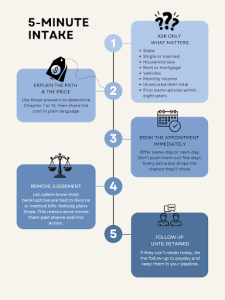
A five-minute intake is not only possible, but it often produces better results than a 30-minute call.
Clients mainly want to know two things: Can you help them, and what will it cost? You can answer this in five minutes or less.
Booking same-day or next-day consults dramatically increases your show rate and retention.
By Philip Tirone, founder and CEO of 720 System Strategies, with decades of experience helping bankruptcy attorneys streamline intake and convert more leads into paying clients.
Why the Five-Minute Law Firm Intake Process Works
Most attorneys treat intake like a legal interview. They ask for too many details up front, the call stretches to half an hour, and meanwhile, other calls are going unanswered. By the time you finish one intake call, you’ve missed two calls from other potential clients, and those two callers have moved onto another firm where someone answers the phone.
Jason Amerine of Castle runs about 60 filings a month, and he often knocks out intake in five minutes. Jason’s firm can handle this volume because they know what matters during an intake: Namely, clients are not looking for a law school lecture. They don’t want to hear the technical legalese of bankruptcy.
They want to feel heard. They want to understand if bankruptcy is even an option, and they want a straight answer about fees. When you meet those needs quickly and give them the next step, you stop them from calling the next attorney down the street, and you move through your consultations faster and more effectively.
In this article, we’ll take a look at what we learned from Jason.
The Five-Minute Framework
So what is the five-minute framework that Jason suggests using as a law firm intake process?
Essentially, the five-minute intake is a process for getting to the heart of the matter and letting potential clients know whether you can help them reach their goals. It cuts out all non-essential information and focuses only on what drives decisions.
“Most of my clients, all they care about is: Can I help them? And what’s it cost? And that doesn’t take a lot of questions to get to that result.”
Let’s look at the five steps of the five-minute intake.
1. Ask only what matters
The first step in the five-minute framework is to focus only on the essentials. Your intake specialist should quickly confirm the caller’s state of residence, marital status, and household size.
From there, gather housing details by asking whether they rent or own, and if it’s a mortgage, clarify the balance, value, and whether payments are current. Ask about vehicles, including the year, make, model, balance owed, payment amount, and timing of the purchase.
Round out the basics by confirming monthly gross income for the debtor (and spouse if married), total unsecured debt, and whether they have filed for bankruptcy within the last eight years.
These questions provide all the information needed to decide next steps without wasting time.
2. Explain the path and the price
Once the essentials are clear, the intake specialist can identify whether the case is likely a Chapter 7 or Chapter 13 at a high level. This isn’t the time for detailed legal analysis. Instead, share the expected chapter and give the fee or a clear range in plain, everyday language. Avoid legal jargon or drawn-out explanations.
Prospects want to know the answer to two questions immediately:
“Can you help?”
“What will it cost?”
Clear and direct answers position the firm as confident, efficient, and trustworthy.
3. Book the appointment immediately
Once the chapter and fee are explained, the next move is to secure the appointment right away. Always offer the soonest available slot, ideally the same day or the next. Pushing the consultation out five days or more significantly lowers the show rate.
Debtors who gather the courage to make that first call are ready to act, and the momentum should not be lost. A strong intake process locks in their commitment while they’re motivated, reducing the risk of them calling another firm.
4. Remove judgment
Throughout the call, the intake specialist must communicate without judgment. Normalize the situation by explaining that most bankruptcies result from divorce or medical events, such as life circumstances that no one plans for. When callers realize they aren’t being judged, their defenses drop, and they are far more likely to trust the process. This simple shift in tone helps clients feel safe, understood, and open to moving forward with the consultation.
5. Follow up until retained
Not every caller will be ready to retain the same day, and that’s where follow-up becomes critical.
If someone says they can move forward on payday, make a note and schedule the follow-up immediately.
Use friendly reminders by phone, text, or email to stay connected and keep the pipeline warm.
To make this easier, you can plug callers directly into the 720 System Strategies automated lead follow-up system for bankruptcy attorneys, which keeps prospects engaged for months (and even years) with texts, emails, and reminders until they are ready to sign.
Consistent follow-up bridges the gap between interest and commitment, ensuring fewer leads fall through the cracks and more prospects ultimately become clients.
Watch & Learn: A Case Study in Onboarding Clients in Five Minutes
Why Speed Beats Sympathy on the First Call
Some attorneys and intake specialists let intake turn into a counseling session. They let callers vent, share every detail, and by the time the call ends, no appointment is booked. Remember: Sympathy is important, but the goal of the first intake is to qualify, quote, and book the consultation. Longer conversations and emotional storytelling come later, after the client has retained the attorney.
FAQ: Should I handle intake calls myself, or should I hire someone else?
Answer: It depends on whether you are comfortable in sales. Jason believes the attorney should run intake, and when he does, he acknowledges the client’s situation, makes clear he isn’t judging, and then keeps the conversation moving toward a decision. His view is that when the client hears directly from the attorney, the client is more likely to trust that the firm can handle the case.
At 720 System Strategies, we often recommend a slightly revised model: Let a trained non-attorney salesperson handle intake, unless the attorney is trained in sales. Our position is this: Intake is fundamentally a sales role, not a legal one. Since sales specialists tend to be less intimidating, they are often better equipped to calm fears, and skilled at overcoming objections so prospects stay engaged and book quickly.
Both approaches can work, depending on the firm. If an attorney is comfortable guiding conversations and strong at building rapport fast, having them lead intake may fit. If not, intake is usually better left to a dedicated specialist.
FAQ: How soon should I schedule the consultation after intake?
Answer: Schedule the consult as soon as possible: Ideally same-day or next-day. When we provide lead qualification services for bankruptcy attorneys, we make live transfers so the attorneys can conduct the consultation as soon as the debtor has been pre-qualified.
Debtors are motivated when they first call. If you push them out five days, your show rate drops. A quick booking keeps them from calling the next attorney on the list.
FAQ: What is the best way to follow up with people who are not ready to file bankruptcy?
Answer: The most effective follow-up combines automation with personal touch.
Add the lead to an automated email or text campaign so no prospect slips through the cracks.
Schedule personal phone calls based on what the lead tells you during intake. For example, if they mention payday or a specific timeline, tie your reminder to that date.
This approach keeps you top of mind without overwhelming the prospect. To make it even easier, you can plug leads into the 720 System Strategies four-year automated follow-up system, which uses consistent texts and emails to keep prospects engaged until they’re ready to move forward.
Philip Tirone is the founder and CEO of 720 System Strategies, a marketing platform built exclusively for consumer bankruptcy attorneys. With decades of experience helping law firms attract, convert, and retain clients, Phil is known for combining advanced targeting strategies with educational follow-up systems that turn hesitant prospects into paying clients. His approach draws from thousands of campaigns nationwide, giving him deep insight into what works, and what wastes money, in bankruptcy marketing.He also shares proven tactics and case studies on his YouTube channel, 720 System Strategies, which is dedicated to helping bankruptcy attorneys grow their practices.
Most consumer bankruptcy attorneys treat client intake and lead qualification like it’s part of the legal work. They get on the phone themselves or hand it off to a paralegal, assuming the job is about quoting the bankruptcy code or explaining petitions.
The reality is different. Bankruptcy lead qualification is not legal work. It is sales. And when a trained non-attorney salesperson takes the first call, everything changes.
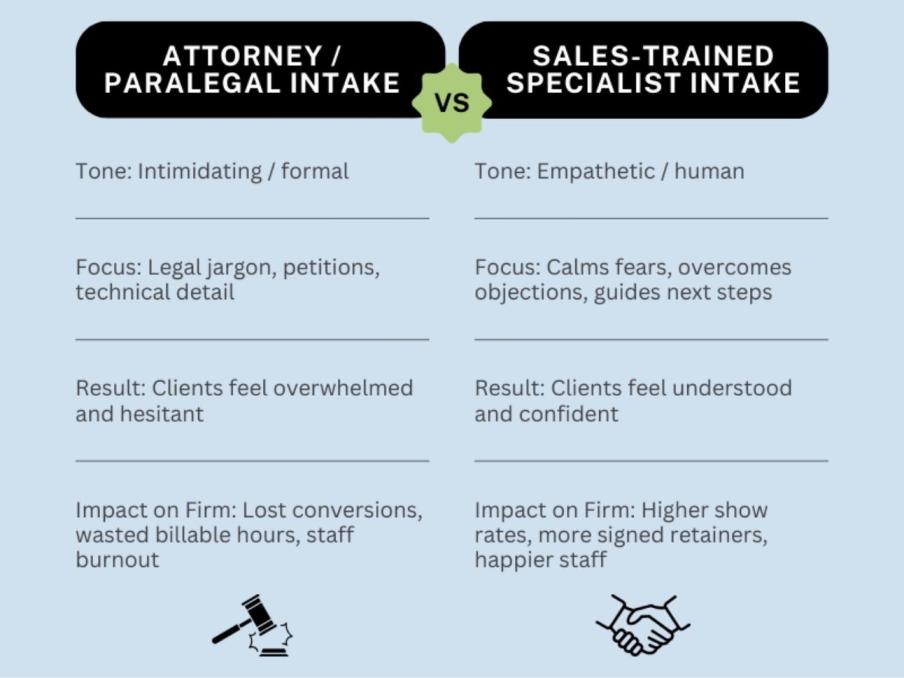
Where an attorney or paralegal can feel intimidating, a salesperson can connect on the debtor’s level. They can calm fears, handle objections, and guide leads toward the next step.
That’s when your conversion rate starts climbing. And once it picks up, it usually takes off fast. In this article, then, let’s look at how putting the right people in the right seat can boost revenue for your firm.
Why Your Time Is Wasted on Bankruptcy Lead Qualification and Intake
If you’ve run a bankruptcy practice for any length of time, you’ve probably taken calls that go nowhere.
Maybe it’s someone making too much money to qualify, or a caller who turns out to live outside your state.
Sometimes it’s a prospect carrying mostly non-dischargeable debt like child support or certain taxes.
Other times, the person simply doesn’t have enough debt (or enough income) to make bankruptcy their best option.
The problem is, every one of those calls eats up valuable time. When paralegals and attorneys are the ones sorting through unqualified leads, their training and expertise get wasted on work that an intake specialist could handle.
Why Attorneys and Paralegals Shouldn’t Be in Charge of Bankruptcy Lead Qualification and Intake
Beyond that, attorneys and paralegals are not sitting in the right seat if they are engaging in lead qualification or intake. Here’s why…
Intake and lead qualification aren’t legal functions. They are sales functions.
A trained salesperson knows how to build rapport, handle objections, and move the conversation toward commitment. That’s not what attorneys went to law school for, and it’s not the best use of paralegal hours either.
When you or your paralegal are seated in the intake and lead qualification seat, here’s what happens:
You lose clients. Successful intake requires someone trained to connect, empathize, and guide. Attorneys often slip into legal jargon that can overwhelm or intimidate debtors. Intake specialists, on the other hand, know how to calm fears, build trust, and keep people moving toward a consultation.
You waste billable hours. Every minute that you or your paralegal spends qualifying a shaky lead is time that could have been billed. Intake doesn’t require a JD, and it pulls attorneys and paralegals away from the high-value work only they can do.
Team morale drops. Paralegals and attorneys studied the law and strategy. They didn’t train for an intake role. When they’re stuck chasing paperwork or running through screening questions, they get frustrated. Over time, burnout rises and turnover follows.
Opportunities slip away. A dedicated intake specialist can nurture leads who aren’t ready to file today but could be ready in a few months. Attorneys rarely have the time or bandwidth to keep those prospects engaged.
Why a Non-Attorney Salesperson Is a Better Approach for Lead Qualification
When you outsource intake or hire a non-attorney salesperson, lead qualification stops being guesswork. A trained intake specialist can follow a clear process, gather the right details, and filter out dead ends so only serious, motivated clients end up on your calendar.
Beyond that, the intake specialist can be tasked with follow-up, making sure that the leads that aren’t quite ready are nurtured until they are ready.
If you’re rethinking how your firm handles bankruptcy lead qualification and intake, check out these FAQs to help you decide what approach fits your practice best.
FAQ: How can I stop wasting time on bankruptcy leads that aren’t qualified?
Answer: You can stop wasting time on unqualified bankruptcy leads by asking disqualifying questions at the beginning of your intake or consultation. Your first few questions should help you uncover information like:
Does this client make enough money to afford bankruptcy?
Do they have the kind of debt that qualifies for bankruptcy?
Have they filed for bankruptcy before?
Are they in your jurisdiction?
You can pre-qualify your clients this in-house or through an outsourced lead qualification service, such as 720 System Strategies, which uses non-attorney salespeople to qualify leads and to overcome objections.
FAQ: Should I outsource my bankruptcy lead qualification?
Answer: You should outsource if you do not have a trained salesperson in-house. Bankruptcy lead qualification should always be handled by someone trained in sales, never by an attorney or paralegal. Here’s why. Most consumer bankruptcy attorneys treat intake and lead qualification like it’s part of the legal work. They either take the calls themselves or delegate to a paralegal, thinking the job is about quoting the code or gathering case details. But that approach misses the point. Intake isn’t legal work. It’s sales work.
Think about what happens on those first calls. A debtor is nervous, embarrassed, and often convinced bankruptcy will ruin their life. If they get an attorney or paralegal on the phone, they’re likely to be hit with technical detail, legal jargon, or even skepticism about whether they should file at all. That overwhelms people and makes them less likely to move forward.
Now picture a trained salesperson in that role. They don’t try to “sound like a lawyer.” Instead, they lower defenses, calm fears, and show the debtor that bankruptcy is a tool for success, not a mark of failure. They know how to handle objections and keep the conversation moving.
When a debtor hears someone explain that they can pay $2,000 to erase $40,000 in debt, the sale almost makes itself.
That’s why having a non-attorney salesperson in this role can double or triple your conversion rate. It’s not because they know more about the law: It’s because they know less about the law and more about sales.
And in bankruptcy, the “product” is relief from crushing debt.
So if you have true sales talent in-house, put them in this role. But if you don’t have a trained salesperson on your staff, outsource to a company like 720 System Strategies.
Either way, never put your attorney or your paralegal in the lead qualification and intake seat. They’re too valuable doing legal work, and they’re simply not wired to close leads the way a trained intake specialist is.
Key takeaway: Bankruptcy lead qualification is a sales job, not a legal one. If you don’t have a trained salesperson in-house, outsource it to 720 System Strategies. Attorneys and paralegals should never be in the intake seat: You’ll get more signed clients when a sales-trained specialist handles those first calls.
FAQ: How can I get more bankruptcy leads to show up for consultations?
Answer: You’ll get more leads to show up when the first call is handled by someone trained in sales, not by an attorney or paralegal.
For most debtors, calling a bankruptcy office is one of the hardest steps they’ll ever take. They’re anxious, embarrassed, and often scared about what bankruptcy will mean for their family. If the very first voice they hear is an attorney or paralegal, the call feels formal and intimidating. That stress makes it much easier for them to cancel or disappear before the consultation.
A sales-trained intake specialist creates the opposite experience. Instead of diving into legal details, they connect with the debtor on a human level, calm their fears, and frame bankruptcy as a smart financial decision. They also know how to handle objections and secure small commitments, like placing a debit card on file, that dramatically increase show-up rates.
The result is simple: a higher show-rate for consultations, fewer wasted hours on no-shows, and more clients retained. Attorneys and paralegals should focus on the legal work. Intake belongs to someone who knows how to sell.
Key takeaway: More bankruptcy leads show up for their consultations when the intake feels safe and encouraging. A sales-trained specialist reduces fear, builds trust, and gets real commitments, something attorneys and paralegals can’t replicate from the intake seat.
FAQ: What questions should be asked during bankruptcy intake?
Answer: Bankruptcy intake should cover both the basics and the questions that move the debtor closer to filing.
Most attorneys focus only on the basics: income, dischargeable debt, prior filings, assets, tax status, and legal actions. (Long-form intake adds more detail like monthly expenses, property, and loan obligations, which gives a clearer picture.) That information is important, but it’s not enough to move a debtor forward.
When you are able to ask questions that ease fears and set up solutions, you will be more likely to convert leads into bankruptcy clients. For example:
“Are you upside down on your vehicle? If so, we can look at options for replacing it.”
“Would you like us to include our credit rebuilding program so you can qualify for a mortgage within two years?”
“When would you like to get this filed? If you sign the paperwork tonight, the collections will stop this week.”
These kinds of questions not only gather facts but also show the debtor that you have a plan to help. They calm nerves, build trust, and make the consultation feel like the natural next step instead of just note-taking.
Key takeaway: The best bankruptcy intake not only collects qualifying information but also asks questions that lead to conversations that calm fears, offer solutions, and move the debtor toward filing. This combination turns a nervous caller into a committed client.
Philip Tirone is the founder and CEO of 720 System Strategies, a marketing platform built exclusively for consumer bankruptcy attorneys. With decades of experience helping law firms attract, convert, and retain clients, Phil is known for combining advanced targeting strategies with educational follow-up systems that turn hesitant prospects into paying clients. His approach draws from thousands of campaigns nationwide, giving him deep insight into what works, and what wastes money, in bankruptcy marketing.He also shares proven tactics and case studies on his YouTube channel, 720 System Strategies, which is dedicated to helping bankruptcy attorneys grow their practices.
The best marketing firms focus on these three things:
Exclusive leads beat shared leads. The best marketing firms deliver leads that belong only to your firm, paired with intake and nurture systems that turn contacts into paying clients.
Follow-up is what drives growth. A four-year nurture sequence with branded texts, emails, and screening keeps hesitant debtors engaged until they’re ready, so no opportunity is wasted.
Reputation fuels referrals. Smart marketing firms use automation to collect reviews at the right time and enroll clients in credit education, which builds credibility and keeps new cases flowing long after the first case closes.
By Philip Tirone
This might come as a surprise, but bankruptcy firms are in the best position they’ve ever been ….
Yes, many attorneys are feeling the pinch of higher ad prices and clients who take their time before filing. Yet those same challenges create space for firms with the right strategy to grow stronger and more consistently than before.
But to be sure, the days of running ads and chasing shared leads are over. To thrive now, attorneys need a smarter
system, one that fills the pipeline, nurtures hesitant clients until they’re ready, and turns more consultations into paying cases. That’s why the best marketing firm for consumer bankruptcy attorneys isn’t defined by flashy ads or big promises. It’s defined by exclusive leads, proven follow-up systems, and a deep understanding of how debtors make decisions.
What Law Firms Really Need From a Bankruptcy Marketing Firm
Attorneys aren’t looking for a pile of cold leads. They want real consultations with people who are ready to discuss bankruptcy. To make that happen, the best marketing firm for bankruptcy attorneys has to deliver five things:
Exclusive leads, so you’re not competing with other attorneys.
Automated follow-up, so no one slips through the cracks.
Intake support, so only qualified clients reach your desk.
Long-term nurturing, because most debtors aren’t ready to file for bankruptcy on day one.
Reputation management, so your past clients generate new referrals.
How One of Our Attorneys Grew His Bankruptcy Firm from $3,000 to $100,000+ / Month
Why Exclusive Leads Matter More Than Ever for Bankruptcy Attorneys
Most directories, like NOLO or LegalZoom, sell the same lead to multiple firms. That’s frustrating for attorneys and confusing for clients. A better approach is exclusive leads that belong only to your firm.
The most effective systems today use advanced targeting, including Facebook and influencer-driven campaigns in specific counties. At 720 System Strategies, our leads typically cost around $35 each, plus $10 when an appointment is set. That’s often half the price of Google PPC, and the return is stronger because of what happens after the lead comes in.
The truth is, our leads aren’t always as “warm” as those found through Google Ads. But we use that to our advantage: Through a structured follow-up system, we educate prospects, address their fears, and remove the barriers that keep so many from moving forward.
And let’s be honest: Even leads who come in “warm” from Google Ads have a high no-show rate. This is because they are still carrying feelings of shame and overwhelm, which can paralyze them.
The key is to use a marketing firm that knows how to educate and nurture debtors, who have a specific set of fears and concerns. By addressing their fears, your marketing firm can inspire hesitant prospects to take the next step and become paying clients.
Our data shows that 30 to 40% of the leads we generate book a consultation within 48 hours. And for the ones who aren’t ready yet, our nurture system keeps them engaged until they are.
Beyond Leads: Intake and Follow-Up That Convert Prospects Into Clients
Leads don’t pay the bills. Clients do. That’s why the real difference-maker comes after someone raises their hand. The best marketing firm for consumer bankruptcy attorneys takes responsibility for what happens next: handling intake and follow-up so prospects don’t slip through the cracks.
That means:
Following up instantly with branded texts and emails
Nurturing long-term with automated campaigns (spanning four years and about 100 touchpoints)
Screening and qualifying prospects so attorneys spend their time with people who are ready to move forward
By the time a prospect reaches you, the heavy lifting should already be done. Other systems (or other people) should have taken care of the warming up so your conversations are focused on filing their case.
Book a call with us to learn more about how we can help your consumer bankruptcy firm.
How Bankruptcy Attorneys Can Use Reputation Management to Get More Referrals
Winning new clients is only part of the equation. The most successful firms also turn past clients into referral sources. A great bankruptcy marketing firm uses automation to consistently generate referrals.
For instance, at 720 Systems Strategies, we enroll your clients in our free credit-education program, 7 Steps to a 720 Credit Score, send educational follow-ups, and then ask for reviews at the right moments. Positive reviews flow to Google, boosting your search rankings and credibility. Negative feedback gets flagged privately, so you can address it before it hurts your brand.
This system not only builds your reputation online but also keeps referrals coming long after a case is closed.
The best bankruptcy marketing firms take a similar approach, recognizing that lead generation is a cycle, one that comes full circle when a past client refers the next client. In fact, check out this 4.9-star image for one of our attorneys!
Why 720 System Strategies Beats Traditional Marketing Agencies
Traditional firms try to serve every practice area. They’ll run Google Ads for a PI firm one day and tweak SEO for an estate planning lawyer the next.
The result?
Cookie-cutter campaigns that don’t address the real barriers that get in the way of filing for bankruptcy: shame, fear, and cost.
720 System Strategies is different. Bankruptcy marketing is all we do. Every campaign, script, and nurture sequence is designed to help debtors move past hesitation and say yes to hiring you.
How One of Our Bankruptcy Attorneys Filed 41 Cases in a Month … Without an Assistant
How to Get Started With 720 System Strategies
Schedule a strategy call, and we’ll map out the right level of support. Start with leads, add follow-up or intake, or go full turnkey. Wherever you begin, we’ll help your firm grow.
Have more questions? Check out our FAQs for answers to the most commonly asked questions.
Why choose 720 Systems Strategies over other marketing firms?
Answer: We provide exclusive leads, automated nurture campaigns, and intake support, so we solve the biggest challenge in this practice area: turning overwhelmed debtors into signed clients.
How is 720 System Strategies different from a traditional marketing firm?
Answer: We focus only on consumer bankruptcy, which makes us the best marketing firm for bankruptcy attorneys. Most marketing agencies juggle multiple practice areas, applying the same generic strategies to personal injury, estate planning, and bankruptcy alike. We specialize in bankruptcy marketing only.
Can a bankruptcy marketing firm really increase my filings?
Answer: Yes, a bankruptcy marketing firm that specializes in debtor psychology and long-term client nurture can directly increase your filings. The key is to working with a bankruptcy marketing firm that knows how to move hesitant prospects past fear and into action.
Most debtors don’t file the day they first raise their hand. They hesitate for weeks or months because of shame, confusion, or misinformation. A generic agency might get you names, but without a system of education and follow-up, those names rarely turn into signed cases.
At 720 System Strategies, every exclusive lead enters a structured nurture process that includes emails, texts, messenger outreach, and phone follow-up. Instead of one or two rushed calls, prospects receive months (and even years) of consistent engagement designed to shift their perspective and help them see bankruptcy as a smart financial decision. That’s what turns leads into clients.
Our data shows the impact: firms using our campaigns see 30–40% of prospects book a consultation within 48 hours. For those who aren’t ready yet, automated nurture continues for up to four years, ensuring no opportunity is wasted.
Watch this clip where Phil Tirone explains how one firm followed up on more than 5,000 Facebook leads with extraordinary results:
As Phil explains, even “raw” Facebook leads achieved a 33% open rate across thousands of emails, numbers that most firms could never achieve on their own. That level of engagement shows that with the right system, bankruptcy leads can and do convert into filings.
Key takeaway: A bankruptcy marketing firm that offers exclusive leads plus long-term nurture fills your calendar and increases the number of cases you file each month.
Answer: We offer individual and turnkey solutions, and the exact pricing depends on which services you choose. For the full pricing breakdown, including lead costs, appointment fees, and optional add-ons, see our related FAQ: “How much does it cost to work with 720 System Strategies?”
What should I look for when choosing a marketing firm for my law practice?
Answer: The most important factors are industry specialization, exclusive leads, intake and nurture support, and proof of ROI. Many agencies will happily sell you names, but then leave your staff to chase those contacts. Without follow-up, most of your marketing spend will get wasted if you go this route.
The best marketing firm for consumer bankruptcy attorneys will help you convert by:
Delivering leads that no other attorney can buy,
Automating consistent communication, and
Offering intake support so you’re speaking only with qualified clients.
It also means showing you clear numbers on cost per lead, cost per client, and return on investment.
At 720 System Strategies, everything we do is designed for bankruptcy attorneys. You can choose a full-service system that covers leads, intake, follow-up, and reputation management, or start with just the pieces your firm needs. Either way, the goal is the same: your marketing dollars translate into signed cases.
Watch how Phil explains why compliance and deliverability matter when you’re deciding on a marketing partner:
Most law firms don’t have the resources to manage text messaging regulations (10DLC), private email servers, and list scrubbing to keep deliverability high. We do that for you, so your campaigns reach the people who need your help.
Key takeaway: The right bankruptcy marketing firm will hand exclusive leads to you and give you a system that turns those leads into paying clients.
Who is the best bankruptcy lead generation company for attorneys?
Answer: 720 System Strategies is the best marketing firm for consumer bankruptcy attorneys, and it is also the best lead generation company.
Plenty of companies claim to deliver bankruptcy leads, but most resell the same contacts to multiple attorneys. That means you’re competing from the moment the lead hits your inbox. 720 System Strategies is different: every lead is exclusive to your firm, targeted to your counties, and backed by long-term nurture sequences that help hesitant debtors move forward.
For a side-by-side comparison with NOLO and to see why exclusivity matters, check out these related FAQs:
How do bankruptcy attorneys get clients without wasting ad spend?
Answer: Bankruptcy attorneys avoid wasted ad spend by focusing on exclusive, targeted leads and pairing them with long-term follow-up. Instead of throwing money at pay-per-click calls that disappear if the client doesn’t hire you immediately, the smarter approach is to invest in campaigns that deliver contacts you own, and then nurture them until they’re ready to file.
The truth is, most people considering bankruptcy aren’t ready to hire the first day they click an ad. Shame, fear, and confusion slow them down. If your only strategy is paying $100 to $150 for a single Google call, you’ll lose a lot of potential clients because there’s no system to bring them back when the timing is right.
At 720 System Strategies, we take a different approach. Leads are exclusive to your firm and cost around $35, plus $10 when an appointment is set. From there, we run the follow-up for you. That means emails, texts, messenger outreach, and even comment engagement on Facebook, more than 100 touchpoints over four years if needed.
By the time you get on the phone with a debtor, they’ve already been educated, reassured, and encouraged to take the next step.
Key takeaway: Bankruptcy attorneys get more clients, without wasting ad dollars, when they stop renting attention and start building relationships. Exclusive leads plus a nurture system make every dollar of ad spend go further, and that’s what turns interest into actual filings.
Is Google Ads or PPC worth it for a bankruptcy law firm?
Answer: It depends on how quickly you want to see results. Google PPC can generate calls quickly, but the cost per lead is often two to three times higher than Facebook or influencer campaigns. Worse, many of those “ready to file” leads don’t actually follow through without proper nurture. That’s why our attorneys often see stronger ROI using lower-cost Facebook leads paired with long-term education and follow-up.
See our full analysis of lead sources and costs here: “How much do bankruptcy leads cost for attorneys?”
What is a good cost per bankruptcy lead for a law firm?
Answer: Anything under $50 per lead is strong in this market. Directory leads (like NOLO) often run $45–$85 and are shared with other firms. Google Ads can be even higher. At 720 System Strategies, our exclusive Facebook and influencer-driven campaigns typically deliver leads around $35, plus a small fee for booked appointments.